Past launch
Launched successfully
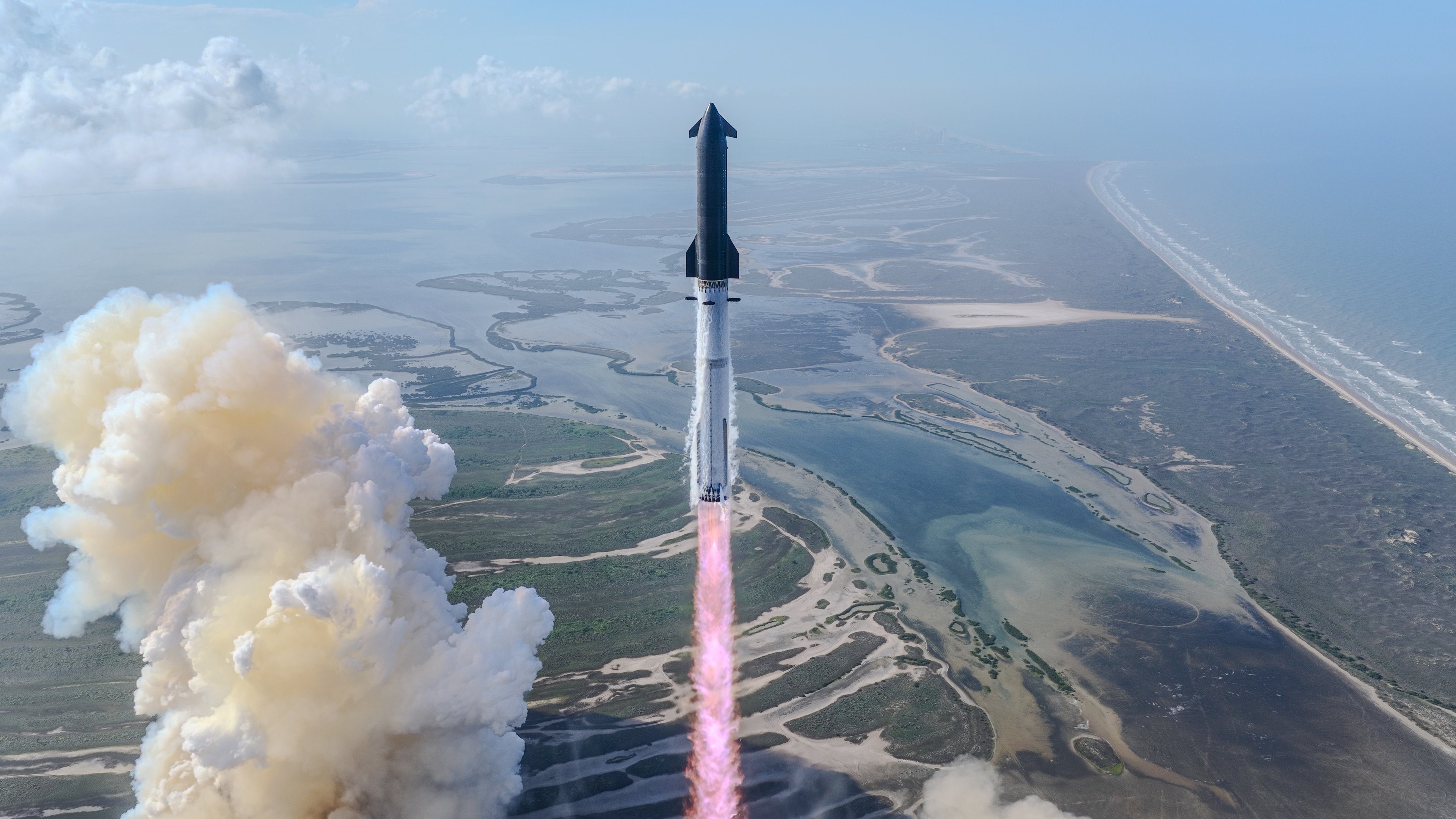
Flight 12
Starship, flown by SpaceX
Launches / Starship
Starship, flown by SpaceX
This was SpaceX's 60th launch of 2026, and its 679th in all.
It was the first launch from Orbital Launch Pad 2 in 2026.
 SpaceX
12th test flight of the two-stage Starship launch vehicle. Maiden Flight of Starship V3. The flight test’s primary goal will be to demonstrate each of these new pieces in the flight environment for the first time, with each element of the Starship architecture featuring significant redesigns to enable full and rapid reuse that incorporate learnings from years of development and test. The Starship upper stage will target multiple in-space and reentry objectives, including a payload deployment of 20 Starlink simulators, similar in size to next-generation Starlink V3 satellites, and two specially modified Starlink satellites. The two modified satellites will test hardware planned for Starlink V3 and will attempt to scan Starship’s heat shield and transmit imagery down to operators to test methods of analyzing Starship’s heat shield readiness for return to launch site on future missions. Several tiles on Starship have been painted white to simulate missing tiles and serve as imaging targets in the test. The Starlink simulators will be on the same suborbital trajectory as Starship. A relight of a single Raptor engine while in space is also planned. For Starship entry, a single heat shield tile has been intentionally removed to measure the aerodynamic load differences on adjacent tiles when there is a tile missing. Finally, the ship will perform experimental actions tested on previous flight tests, including a maneuver to intentionally stress the structural limits of the vehicle’s rear flaps and a dynamic banking maneuver to mimic the trajectory that future missions returning to Starbase will fly.
The SpaceX Starship is a fully reusable super heavy-lift launch vehicle under development by SpaceX since 2012, as a self-funded private spaceflight project. The second stage of the Starship — is designed as a long-duration cargo and passenger-carrying spacecraft. It is expected to be initially used without any booster stage at all, as part of an extensive development program to prove out launch-and-landing and iterate on a variety of design details, particularly with respect to the vehicle's atmospheric reentry.
Third development version of the Starship reusable two-stage super heavy-lift launch vehicle.
First stage Second stage
Simulated from the published flight plan. The climb flattens as the rocket pitches over to build sideways speed, which is why a launch stays visible so far from the pad. A dashed line is a stage that separates and flies back down, either to the pad or to a ship waiting downrange.
Going to watch it in person? Flyby's Pathfinder points your camera at the pad, so you are not stood there guessing which one it goes up from. It puts this same climb on a globe you can turn, too.
Space Exploration Technologies Corp., known as SpaceX, is an American aerospace manufacturer and space transport services company headquartered in Hawthorne, California. It was founded in 2002 by entrepreneur Elon Musk with the goal of reducing space transportation costs and enabling the colonization of Mars. SpaceX operates from many pads, on the East Coast of the US they operate from SLC-40 at Cape Canaveral Space Force Station and historic LC-39A at Kennedy Space Center. They also operate from SLC-4E at Vandenberg Space Force Base, California, usually for polar launches. Another launch site is being developed at Boca Chica, Texas.
724 launches so far, 709 of them successful. The last 209 in a row went to plan.
It went up from Orbital Launch Pad 2 at SpaceX Starbase, TX, USA.
This one is done, but there is another along shortly. Flyby works out whether it climbs into your sky, and wakes you in time to get outside.
Get Flyby free