Past launch
Launched successfully
Nancy Grace Roman Space Telescope
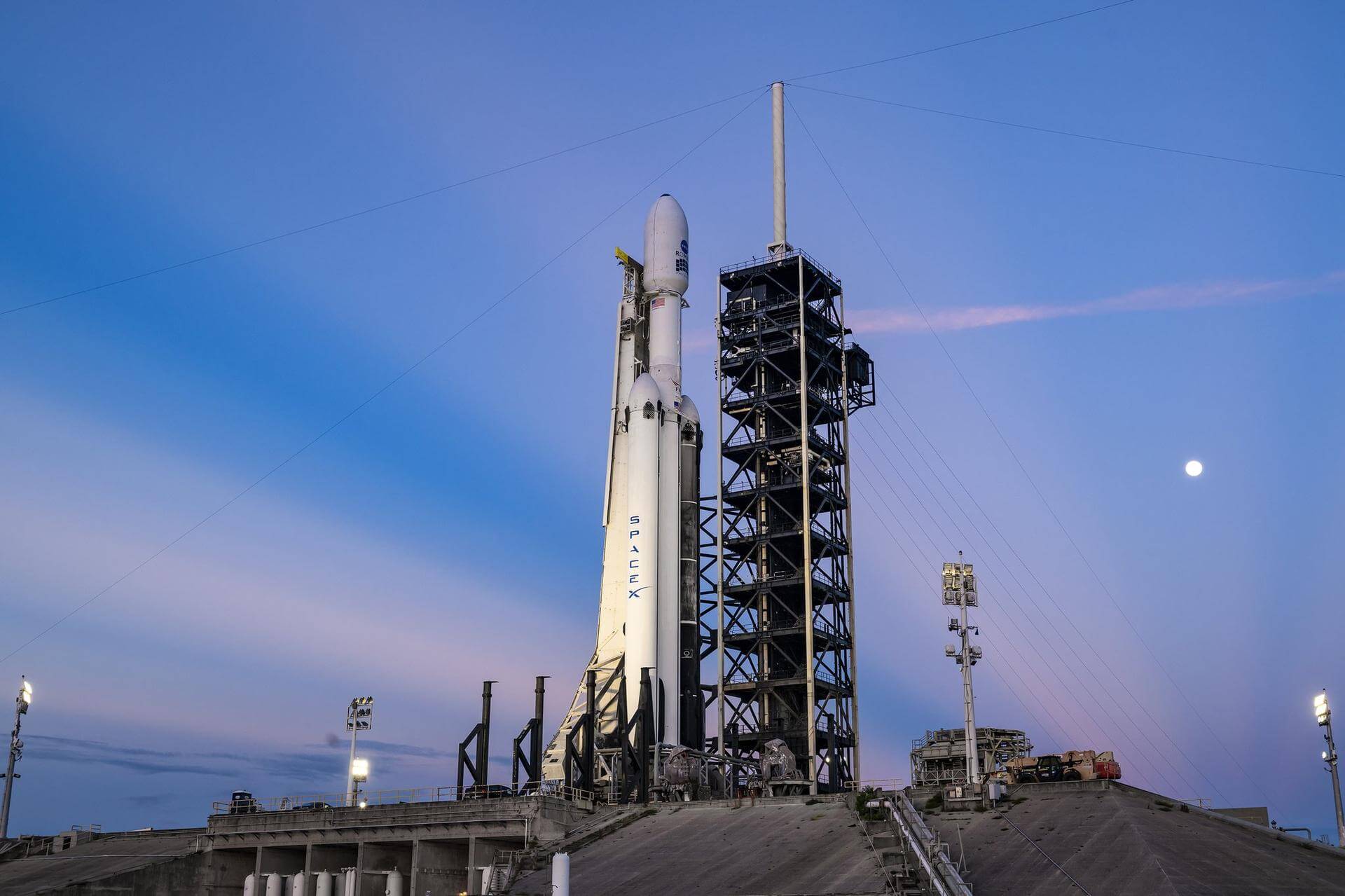
Falcon Heavy, flown by SpaceX
Launches / Falcon Heavy
Falcon Heavy, flown by SpaceX
This was SpaceX's 105th launch of 2026, and its 724th in all.
Counting every operator, it was the 206th orbital launch attempt anywhere in 2026, and the second from Launch Complex 39A.
 SpaceX
The Nancy Grace Roman Space Telescope is a NASA infrared space telescope with a 2.4 m (7.9 ft) wide field of view primary mirror and two scientific instruments. The Wide-Field Instrument (WFI) is a 300.8-megapixel multi-band visible and near-infrared camera, providing a sharpness of images comparable to that achieved by the Hubble Space Telescope over a 0.28 square degree field of view, 100 times larger than imaging cameras on the Hubble. The Coronagraphic Instrument (CGI) is a high-contrast, small field of view camera and spectrometer covering visible and near-infrared wavelengths using novel starlight-suppression technology. Roman objectives include a search for extra-solar planets using gravitational microlensing, and probing the expansion history of the Universe and the growth of cosmic structure, with the goal of measuring the effects of dark energy, the consistency of general relativity, and the curvature of spacetime.
The Falcon Heavy is a variant of the Falcon 9 full thrust launch vehicle and consists of a standard Falcon 9 rocket core, with two additional boosters derived from the Falcon 9 first stage.
13 flights, 13 of them successful. 23 boosters brought back from 25 attempts.
First stage Second stage Side booster
Simulated from the published flight plan. The climb flattens as the rocket pitches over to build sideways speed, which is why a launch stays visible so far from the pad. A dashed line is a stage that separates and flies back down, either to the pad or to a ship waiting downrange.
Going to watch it in person? Flyby's Pathfinder points your camera at the pad, so you are not stood there guessing which one it goes up from. It puts this same climb on a globe you can turn, too.
Space Exploration Technologies Corp., known as SpaceX, is an American aerospace manufacturer and space transport services company headquartered in Hawthorne, California. It was founded in 2002 by entrepreneur Elon Musk with the goal of reducing space transportation costs and enabling the colonization of Mars. SpaceX operates from many pads, on the East Coast of the US they operate from SLC-40 at Cape Canaveral Space Force Station and historic LC-39A at Kennedy Space Center. They also operate from SLC-4E at Vandenberg Space Force Base, California, usually for polar launches. Another launch site is being developed at Boca Chica, Texas.
724 launches so far, 709 of them successful. The last 209 in a row went to plan.
It went up from Launch Complex 39A at Kennedy Space Center, FL, USA.
This one is done, but there is another along shortly. Flyby works out whether it climbs into your sky, and wakes you in time to get outside.
Get Flyby free