Past launch
Launched successfully
Fengyun-3H
Long March 4C, flown by China Aerospace Science and Technology Corporation
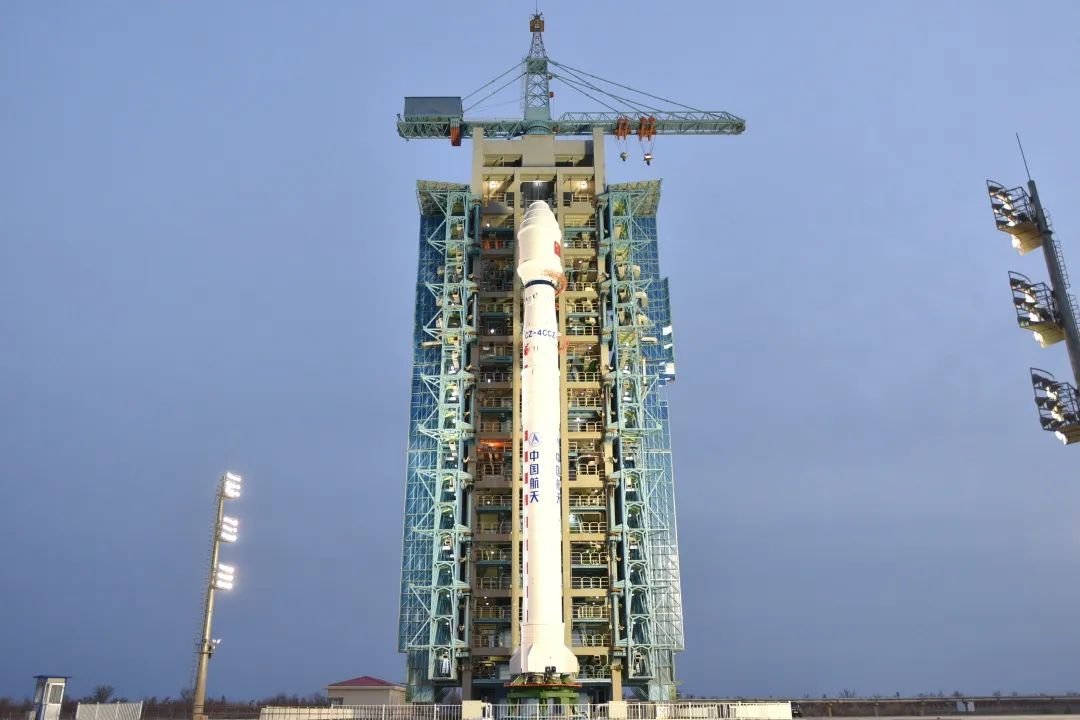
Launches / Long March 4C
Long March 4C, flown by China Aerospace Science and Technology Corporation
This was China Aerospace Science and Technology Corporation's 42nd launch of 2025, and its 543rd in all.
Counting every operator, it was the 225th orbital launch attempt anywhere in 2025, and the ninth from Launch Area 94 (SLS-2 / 603).
 China Aerospace Science and Technology Corporation
The Fengyun-3 (FY-3) series is the 2nd generation of Chinese polar-orbiting meteorological satellites, following on from the FY-1 series. The series has been developed collaboratively by CMA (Chinese Meteorological Administration) and CNSA (China National Space Administration). The FY-3 series’ objectives are to provide global measurements of 3-D temperature and moisture soundings, cloud and precipitation parameters, meteorological and hydrological events, biosphere anomalies and geophysical parameters in support of global change and climate monitoring.
The Long March 4C, also known as the Chang Zheng 4C, CZ-4C and LM-4C, previously designated Long March 4B-II, is a Chinese orbital carrier rocket. It is launched from the Jiuquan, Taiyuan Satellite Launch Centre and Xichangs, and consists of 3 stages. Long March 4C vehicles have been used to launch the Yaogan-1, Yaogan-3 SAR satellites and the Fengyun-3A polar orbiting meteorological satellite. On December 15, 2009 a Long March 4C was used to launch Yaogan 8.
60 flights, 58 of them successful.
China Aerospace Science and Technology Corporation
The China Aerospace Science and Technology Corporation (CASC) is the main contractor for the Chinese space program. It is state-owned and has a number of subordinate entities which design, develop and manufacture a range of spacecraft, launch vehicles, strategic and tactical missile systems, and ground equipment. It was officially established in July 1999 as part of a Chinese government reform drive, having previously been one part of the former China Aerospace Corporation. Various incarnations of the program date back to 1956.
612 launches so far, 596 of them successful. The last 3 in a row went to plan.
It went up from Launch Area 94 (SLS-2 / 603) at Jiuquan Satellite Launch Center, China.
This one is done, but there is another along shortly. Flyby works out whether it climbs into your sky, and wakes you in time to get outside.
Get Flyby free