Past launch
Launched successfully
3 x Rodnik (Kosmos 2585, 2586, 2587)
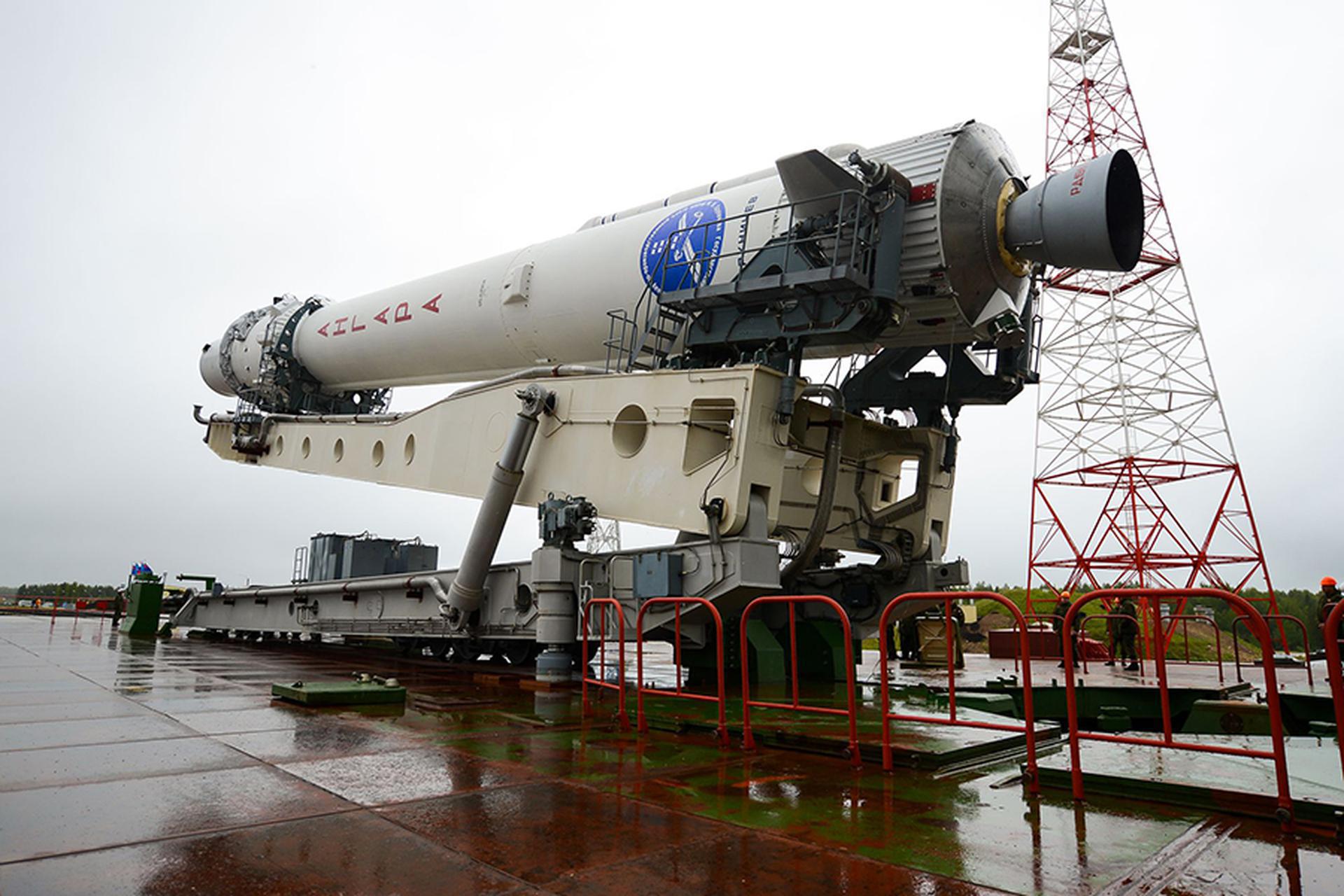
Angara 1.2, flown by Russian Space Forces
Launches / Angara 1.2
Angara 1.2, flown by Russian Space Forces
This was Russian Space Forces' 3rd launch of 2025, and its 147th in all.
Counting every operator, it was the 55th orbital launch attempt anywhere in 2025, and the first from 35/1.
 Russian Space Forces
Note: Payload identity and Cosmos series numbering not confirmed. The Strela (Russian: Стрела) are Soviet, then Russian, military space telecommunication satellites, in use since 1964. These satellites operate as mailboxes ("store-and-forward"): they remember the received messages and then resend them after the scheduled time, or by a command from the Earth. They can serve for up to five years. The satellites are used for transmission of encrypted messages and images. The operational constellation consists of 12 satellites in two orbital planes, spaced 90° apart. The spacecraft had a cylindrical body with a gravity-gradient boom, which was extended on-orbit to provide passive attitude stabilization. On-board storage was 12 Mbits of data, with a transmission rate of 2.4 kbit/s. The first three satellites were launched in 1964 by a Cosmos launcher. After one year of service, new and improved satellites were launched, called Strela-2. In 1970, these satellites were modernized, and became the Strela-1M and Strela-2M satellites. From 1985, these satellites will be gradually replaced by Strela-3, and then by Strela-3M from 2005. A civilian version of these satellites was created, called Goniets. Initially they were launched in groups of six on Tsyklon; when the launcher was retired, they were only launched by two on Cosmos, before Rokot was put into service and allowed the sending of triplets of Strela satellites.
The Angara 1.2 is the base launcher for the Angara launch family that uses a modular approach to create multiple launch vehicle configurations for various mission requirements. The Angara 1.2 consists of a standard Universal Rocket Module for the core stage and either a modified Block I Upper Stage or a Briz-KM upper stage.
7 flights, 7 of them successful.
Russian Space Forces
The Russian Space Forces are a branch of the Russian Aerospace Forces, that provides aerospace warning, air sovereignty, and protection for Russia. Having been reestablished following August 1, 2015 merger between the Russian Air Force and the Russian Aerospace Defence Forces after a 2011 dissolving of the branch. The Russian Space Forces were originally formed on August 10, 1992 and the creation of the Russian Armed Forces.
157 launches so far, 149 of them successful. The last 69 in a row went to plan.
This one is done, but there is another along shortly. Flyby works out whether it climbs into your sky, and wakes you in time to get outside.
Get Flyby free